Space Weather: The G5 Storm That Blacked Out Quebec
On March 13, 1989, six million people in Quebec lost power for nine hours.
On March 13, 1989, six million people in Quebec lost power for nine hours. The cause was not a storm in any conventional sense — no rain, no wind, no pressure gradient. A geomagnetic storm rated G5, the highest level on NOAA's five-point scale, drove currents through the ground that overwhelmed Hydro-Québec's transformers and collapsed the grid in under two minutes. The storm was triggered by a coronal mass ejection, a billion-ton cloud of magnetized plasma that the Sun had launched toward Earth three days earlier.
Nothing on that scale moved this week, but the physics that made 1989 possible is operating continuously.
What the Sun Is Actually Doing
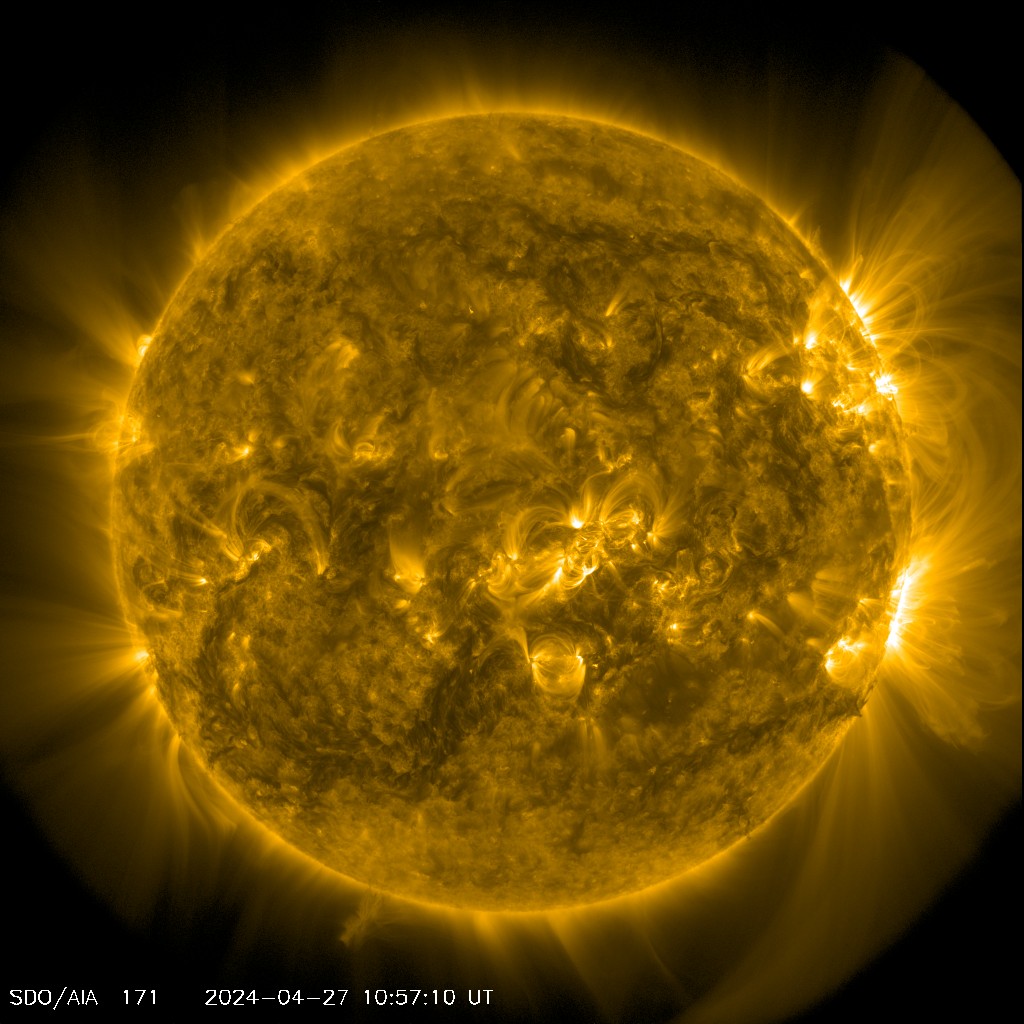
The Sun does not radiate uniformly. Its surface is threaded with magnetic field lines that emerge from sunspot regions — cooler, darker patches where intense magnetism suppresses convective heat from below. Sunspots are not passive features. When their field lines tangle and reconnect, they release stored magnetic energy in sudden bursts: solar flares. A flare classified as X-class is the most energetic category, capable of delivering its radiation — traveling at the speed of light — to Earth in about eight minutes. That radiation ionizes the upper atmosphere on the sunlit side of the planet, absorbing HF radio signals and degrading or blacking out communications used by aviation and emergency services.
NASA SDO
The flare itself, though, is only the opening act. The more consequential event is a coronal mass ejection, which may or may not accompany a flare. A CME is a coherent structure — not a diffuse gust but a magnetized cloud with its own internal field orientation. It travels at anywhere from 250 to 3,000 kilometers per second. At the fast end, it reaches Earth in under 18 hours. At the slow end, transit takes three to four days. The critical variable on arrival is not speed but the orientation of the CME's magnetic field. If it points southward — opposite to Earth's northward-facing magnetospheric field — the two fields connect through a process called magnetic reconnection, and energy floods into the magnetosphere. A northward-pointing CME can pass largely without consequence regardless of its size.
This is why space weather forecasting is genuinely difficult. NOAA's Space Weather Prediction Center can detect a CME leaving the Sun and estimate its arrival window, but the field orientation typically cannot be confirmed until the cloud reaches the L1 Lagrange point, roughly 1.5 million kilometers sunward of Earth — about 15 to 60 minutes before impact, depending on CME speed. That is a narrow window to act on a grid protection decision.
The Kp Index and What It Measures
Geomagnetic storm intensity is quantified by the Kp index, a global average of magnetic field disturbance measured at ground stations every three hours, running from 0 (quiet) to 9 (severe). NOAA maps Kp onto its G-scale: G1 begins at Kp 5, G5 corresponds to Kp 9. The 1989 Quebec event reached Kp 9.
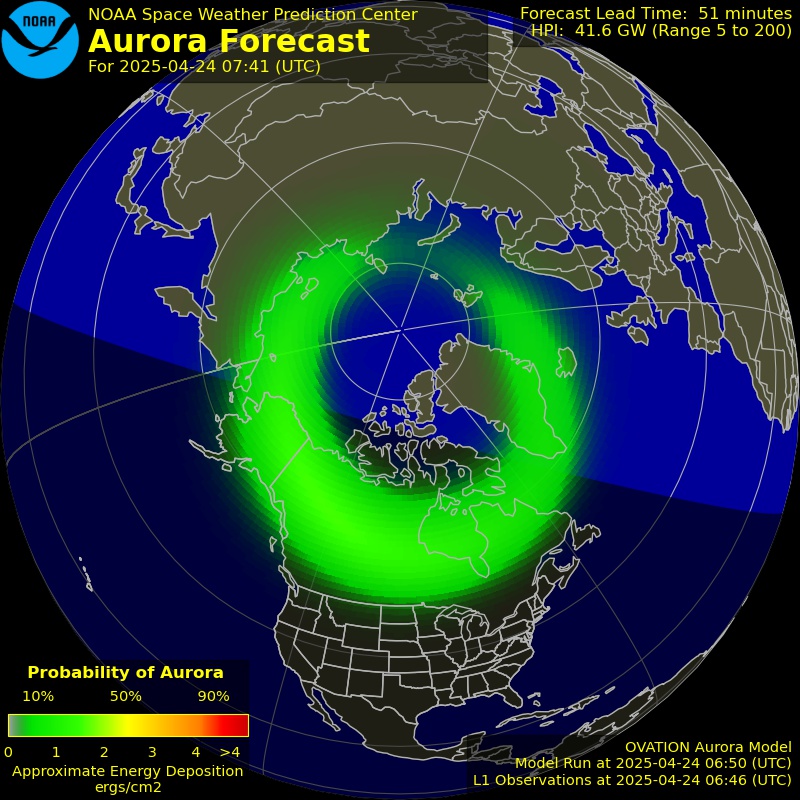
The Kp index matters practically because it determines where auroras become visible. At Kp 5, the aurora oval expands to roughly 55° geomagnetic latitude — northern Michigan, southern Canada. At Kp 7, it reaches 45°, which puts it over the northern United States and central Europe. At Kp 9, the oval can extend to 40° or below, which is why auroras were reported in Texas and Cuba during the most intense storms of the 20th century.
 NOAA SWPC
The solar cycle runs approximately 11 years from minimum to maximum and back. Solar Cycle 25, the current one, reached its predicted maximum in late 2024 and is tracking above the consensus forecast issued at cycle start. More sunspot activity means more flares, more CMEs, and a higher probability of significant geomagnetic storms through the next two to three years before activity subsides again.
Heads Up
Monitor the NOAA Space Weather Prediction Center's 3-day forecast (swpc.noaa.gov) if you operate HF radio, work in aviation dispatch, or manage any infrastructure sensitive to induced ground currents — the site posts Kp forecasts and active alerts in near-real time. If a G3 or higher storm is forecast, aurora watchers at latitudes as low as 45° should check after local midnight, when the oval is typically most active and the geometry most favorable. Satellite operators and GPS-dependent systems face the most persistent risk not from the brief flare pulse but from the days-long elevated particle environment that follows a major CME — a detail that gets less public attention than the aurora photos.
 United States Air Force