
Ocean Heat Transport: Why Bergen Beats Anchorage
Bergen, Norway sits at 60.4° N — roughly the same latitude as Anchorage, Alaska.
Bergen, Norway sits at 60.4° N — roughly the same latitude as Anchorage, Alaska. Bergen's January average is 3°C. Anchorage's is -9°C. That 12-degree gap isn't a quirk of local geography. It's the signature of one of the most powerful heat-transport systems on Earth.
The ocean moves heat. Not metaphorically — physically, in prodigious quantities. The Atlantic Meridional Overturning Circulation (AMOC) alone transports roughly 1.3 petawatts of thermal energy northward, a figure comparable to a million large power plants running continuously. The Gulf Stream is AMOC's most visible surface component, a river of warm, salty water that flows north along the U.S. East Coast before crossing toward Europe. Without it, northwestern Europe's climate would look a lot more like Labrador's.
NASA
How the Engine Runs
AMOC is a density-driven system. Warm surface water flows north, releases heat to the atmosphere (which is why London has rain in January rather than permafrost), and then cools and becomes denser. Dense water sinks — particularly in the Labrador Sea and the Nordic Seas — and flows southward along the ocean floor. This is the thermohaline circulation: thermo for temperature, haline for salinity. Both variables control density, and density controls everything.
The loop is self-sustaining under stable conditions. Saltier water is denser and sinks more readily, which pulls more warm surface water northward, which releases more heat, which drives more evaporation, which concentrates more salt. The system has run in this configuration for thousands of years. The problem is that fresh water disrupts it. Fresh water is less dense. Add enough of it — from melting ice sheets, for instance — and the sinking mechanism weakens. Proxy records from ice cores and deep-sea sediments show that AMOC has slowed or collapsed before, most dramatically during the Younger Dryas, roughly 12,900 years ago, when a massive pulse of glacial meltwater into the North Atlantic appears to have triggered a return to near-glacial temperatures across the Northern Hemisphere within decades.
 NASA / NOAA
Current measurements from the RAPID array — a mooring system deployed across the Atlantic at 26.5° N — show that AMOC has weakened by roughly 15% since the mid-20th century, though the uncertainty bands on that estimate are wide and the debate about attribution is ongoing. Nothing major moved on this front this week, but the monitoring continues.
![Diagram of Atlantic thermohaline circulation showing warm surface flow northward and cold deep return flow southward]
The Pacific Does It Differently
The Pacific's dominant heat-redistribution mechanism isn't a conveyor belt — it's an oscillation. El Niño-Southern Oscillation (ENSO) cycles between two phases that reorganize sea surface temperatures across the tropical Pacific and, through atmospheric teleconnections, reshape weather patterns globally.
During El Niño, trade winds weaken, warm water sloshes eastward toward the central and eastern Pacific, and the thermocline — the sharp temperature boundary between warm surface water and cold deep water — tilts. Sea surface temperatures in the eastern Pacific rise by 1 to 3°C above average, sometimes more. That sounds modest. The consequences are not. The 1997-98 El Niño, one of the strongest on record, contributed to catastrophic flooding in Peru, a severe drought in Indonesia that fueled massive forest fires, a collapse of anchovy fisheries off the South American coast, and a notably quiet Atlantic hurricane season. All from a few degrees of anomalous warmth in the right place.
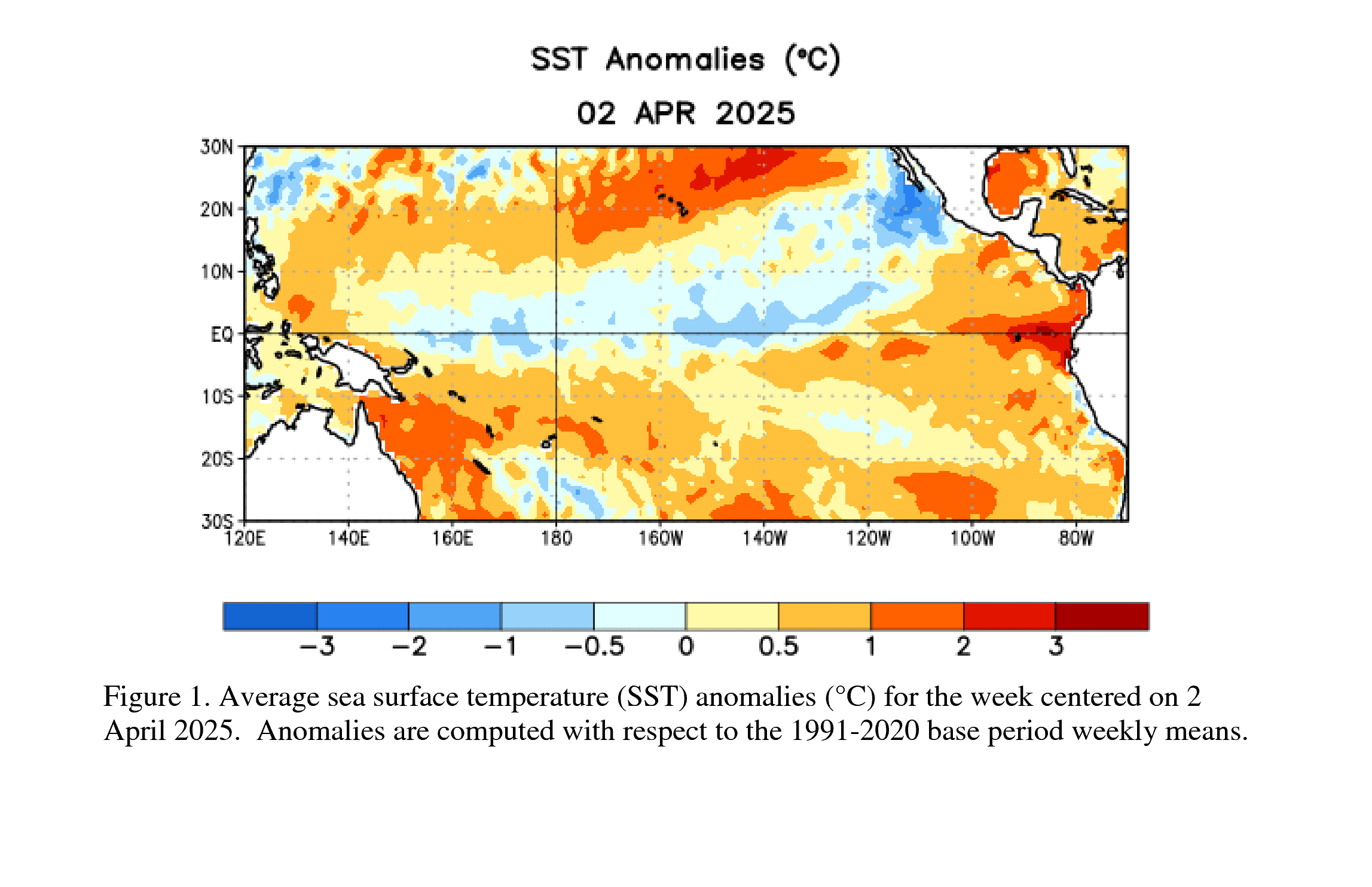 NOAA CPC
La Niña reverses the pattern: trade winds strengthen, cold upwelling intensifies along the South American coast, and the western Pacific warm pool expands. La Niña years tend to bring drought to the southern United States and above-normal Atlantic hurricane activity. The 2020-21-22 triple-dip La Niña — three consecutive La Niña winters — was unusual in duration and contributed to a multi-year drought across the American Southwest.
![Map showing sea surface temperature anomalies during the 1997-98 El Niño event]
Marine Heatwaves: The Emerging Signal
Ocean heat transport is a background condition. Marine heatwaves are acute events — periods when sea surface temperatures in a region exceed the 90th percentile for that location and time of year, sustained for at least five days. They've become more frequent, more intense, and longer-lasting. The Northeast Pacific marine heatwave of 2013-2015, nicknamed "the Blob," raised sea surface temperatures across an area the size of the contiguous United States by up to 4°C above average. It disrupted the food web from zooplankton to salmon to humpback whales, triggered toxic algal blooms that closed shellfish harvesting along the California coast, and contributed to the collapse of the Pacific cod stock in the Gulf of Alaska.
The 2023 North Atlantic marine heatwave was more extreme by the numbers: sea surface temperatures reached 5 to 6°C above average across parts of the basin in late summer, setting records in a dataset that goes back to 1850. Whether that event represents a new baseline or an outlier is a question researchers are still working through.
Field Notes
- The RAPID array at 26.5° N is the primary real-time monitoring system for AMOC strength; its data is publicly accessible and updated regularly through the UK National Oceanography Centre.
- ENSO state is tracked by NOAA's Climate Prediction Center using the Oceanic Niño Index (ONI), a three-month running average of sea surface temperature anomalies in the Niño 3.4 region; knowing the current ONI value gives you useful context for seasonal forecasts across North America.
- When a marine heatwave is reported, the relevant number is how many degrees above the climatological average, not the absolute temperature — a 3°C anomaly off Alaska is biologically significant in ways a 3°C anomaly in the tropics is not.