
This Week in Weather — April 27, 2026
67 tornadoes in seven days across Kansas, Texas and Missouri, an X2.5 flare with no geomagnetic follow-through, and 8.42 inches aimed at Dallas.
Rearview
Sixty-seven confirmed tornadoes in seven days. That number alone would mark a significant outbreak week, but the geography makes it more precise: Kansas logged 168 total storm reports, Texas 155, Missouri 113, Oklahoma 111, and Mississippi 91 — a corridor that lit up almost continuously through the back half of the week.
The sharpest concentration came overnight on April 27, when the Springfield, Missouri NWS office (SGF) issued tornado warnings in rapid succession across Greene, Polk, Dallas, Webster, Boone, Callaway, Cole, and Moniteau counties. The Tulsa office (TSA) had Osage County, Oklahoma under a tornado warning at 01:41Z; Wichita (ICT) had Labette County, Kansas at 01:29Z. Six separate tornado warnings in roughly 25 minutes across three states — the kind of sequence that reflects a well-organized, fast-moving supercell complex rather than isolated discrete storms.
NOAA NESDIS
The 995 total NWS warnings for the week included 641 severe thunderstorm warnings and 509 hail reports — hail volume that typically signals large, persistent updrafts. The 509 hail reports against 356 wind reports is a ratio worth noting: hail-dominant outbreaks tend to correlate with more discrete supercell modes rather than linear squall lines, which is consistent with the tornado count.
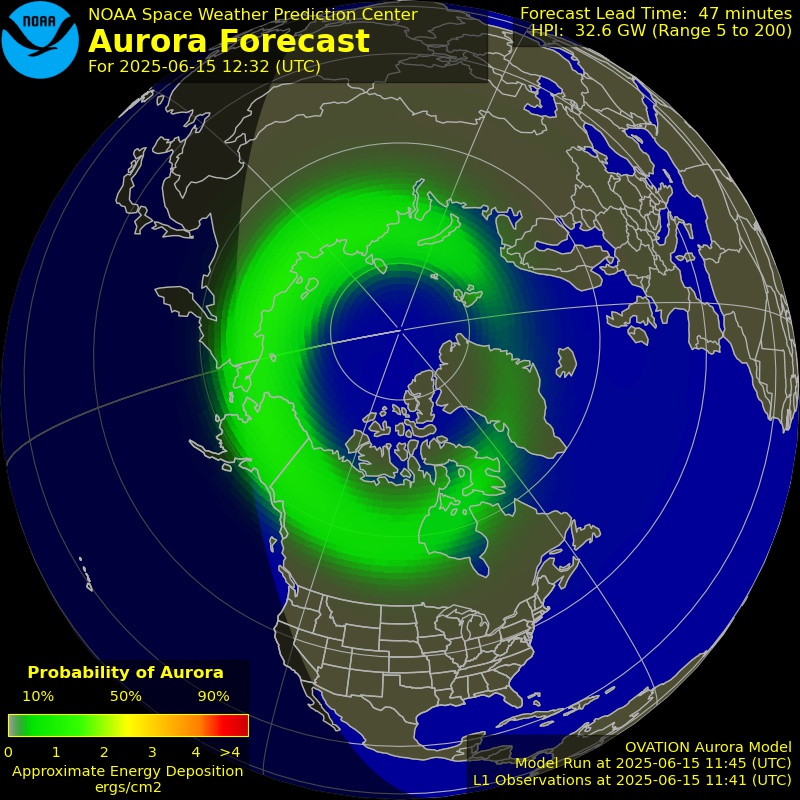
On April 24, the sun produced an X2.5 flare at 08:13Z — the strongest flare of the past week by a wide margin. Kp index remained flat (max Kp: 0), so the flare did not translate into geomagnetic activity at Earth. Watch for aurora potential to stay suppressed unless a coronal mass ejection from that event arrives later than modeled.
The week's largest seismic event was a magnitude 7.4 on April 20, centered 100 km ENE of Miyako, Japan, with a tsunami warning issued. Closer to home: a magnitude 4.0 struck 1 km WNW of Cooter, Missouri, and a magnitude 4.8 hit 19 km SE of Silver Springs, Nevada — both minor but notable given their locations in the central U.S. and Basin and Range province.
Roadmap
The dominant pattern for the coming week is a persistent upper-level trough anchored over the central Rockies and High Plains, with a downstream ridge attempting to build along the East Coast. That setup keeps the storm track active across the south-central U.S. while the Northeast oscillates between mild and unsettled and the West Coast sits under an anomalously quiet, dry ridge.
The South Plains signal is the most striking in the data. Dallas-area forecast totals reach 8.42 inches of precipitation for the week, with peak probability (62%) landing May 1. That is not a typo — 8.42 inches in seven days would rank among the wettest weeks on record for the Dallas-Fort Worth area, and it reflects the same trough-induced moisture return that drove last week's outbreak. Severe weather risk does not go away with this pattern; it reorganizes. Anyone in the Southern Plains corridor from central Texas through Oklahoma should treat the May 1 window as a watch period, not a weather curiosity.
 NASA
NASA
Denver picks up 1.62 inches through the week, with the highest precipitation probability (83%) on April 30 — consistent with the trough axis swinging through the Mountain West late in the period. Snow levels in the Colorado Rockies will depend on the exact thermal profile, but late-April systems in this pattern frequently deliver heavy snow above 8,000 feet while the Front Range sees rain and mud. The I-70 mountain corridor is worth watching for travel impacts April 29-30.
The Northeast sees 0.57 inches total, with the highest probability (93%) already behind us as of April 26 — meaning the bulk of that precipitation has likely already fallen by the time this publishes. Average highs around 61°F in the New York area reflect the cool side of the trough influence, but no significant severe weather signal exists for the region this week. Atlanta averages 74°F with 1.19 inches spread across the period, peak probability 71% on April 29, which aligns with the trough's eastern progression.
San Francisco is the outlier: zero projected precipitation, 6% peak probability, average high of 64°F. The ridge over the West Coast is effectively a lid. For a region that tracks every rain event through a multi-year drought lens, a dry week in late April is not unusual — but it continues a pattern of below-normal spring precipitation that has characterized 2026 so far for coastal California.
 NOAA SWPC
London's forecast high averages 65°F for the week — warmer than Chicago's 55°F — which reflects a persistent Atlantic pattern that has kept western Europe mild while the U.S. Midwest sits under cooler, unsettled flow. No significant European storm signal appears in the data for this period.
Bottom Line
- The South Plains faces a potentially historic precipitation week, with Dallas-area totals forecast near 8.42 inches through May 1 — flash flood and severe weather risk remain elevated across the same corridor that produced 67 tornadoes last week.
- Denver and the Colorado Front Range should plan for a significant Mountain West system April 29-30, with heavy snow likely above 8,000 feet and travel disruptions possible on I-70.
- The X2.5 solar flare on April 24 did not produce geomagnetic activity, and aurora probability remains low for the coming week barring a late-arriving CME — check Kp forecasts before making plans for high-latitude viewing.