
This Week in Weather — May 18, 2026
Six Iowa tornado warnings in 13 minutes, a wind-dominant week of 694 severe thunderstorm warnings, and an M6.7 off Ōfunato, Japan.
Rearview
Six tornado warnings in 13 minutes across north-central Iowa on the evening of May 17 (local CDT) is the sharpest single-cluster sequence in this week's dataset. Starting at 9:05 p.m. CDT, the Des Moines NWS office and its Omaha counterpart issued warnings covering Emmet, Calhoun, Hamilton, Webster, Humboldt, Kossuth, Palo Alto, Pocahontas, Wright, Mills, Montgomery, and Pottawattamie counties — a swath stretching from the Missouri River bluffs northeast into lake country. The full 79-warning tornado total for the week sits inside a broader severe weather footprint of 694 severe thunderstorm warnings and 1,041 NWS products issued nationally.
NOAA NESDIS
Storm report geography tells a regional story: Nebraska led all states with 157 combined tornado, hail, and wind reports, followed by Idaho (121), Kansas (104), Montana (92), and Missouri (85). The 231 hail reports against 692 wind reports reflects a wind-dominant outbreak pattern — squall lines rather than discrete supercells driving most of the damage.
 NOAA
NOAA
On May 15, a M6.7 struck 49 km ESE of Ōfunato, Japan at 11:22 UTC — the week's largest seismic event. Ōfunato sits on the Sanriku coast of Iwate Prefecture, a region with acute tsunami sensitivity given its 2011 history. A separate M6.0 occurred near Codrington, Antigua and Barbuda, adding to a week that logged 79 earthquakes at M4.5 or greater globally.
Space weather stayed quiet. The week's peak Kp index was 0, and the lone notable solar event — an M2.0 flare at 17:42 UTC on May 16 — produced no significant geomagnetic response. For context, M2.0 sits near the low end of the medium-flare range; without an associated coronal mass ejection directed at Earth, it's radio noise, not a grid concern.
Roadmap
The dominant large-scale feature shaping the coming week is a persistent trough axis over the Rockies and central High Plains, with a ridge building along the West Coast. That configuration channels Gulf moisture northward into the central U.S. while keeping the Pacific coast under a subsidence lid, and it positions the jet stream in a way that repeatedly fires convection from the South Plains through the Midwest on a nearly daily cadence.
Mountain West and South Plains (May 19 primary target)
Denver carries a 95% precipitation probability on May 19 — the highest single-day figure in the national dataset this week — with 1.93 inches of total accumulation projected across the seven-day period. That number is substantial for a semi-arid climate where May averages roughly 1.7 inches for the entire month. The mechanism is the trough itself: as its base digs toward the Four Corners, it draws moisture upslope along the Front Range and triggers orographic lift that can sustain precipitation well into the afternoon hours. Dallas sees a parallel signal on the same date (68% probability, 1.32" weekly total), consistent with the same trough pulling Gulf air northward into a convergence zone across north Texas.
Northeast and Midwest
New York City's average high of 80°F this week is warm for mid-May — the 30-year normal for Central Park on May 20 is around 68°F — and the 81% precipitation probability on May 20 suggests a frontal passage timed to the trough's eastward progression. Chicago, cooler at a 68°F average high, sees its own 62% probability on May 19, which places the Midwest event slightly ahead of the Northeast event in the sequence. That day-by-day eastward march is the textbook signature of a shortwave rotating around the base of the trough and lifting into the Ohio Valley before reaching the Mid-Atlantic.
Southeast
Atlanta's 89°F average high is the warmest regional figure in the dataset, and the 60% precipitation probability on May 21 arrives a day after the Northeast event — consistent with the front stalling or weakening as it moves into higher-pressure territory over the Gulf states. The weekly accumulation of 1.40 inches is moderate but not exceptional; the primary hazard here is heat, not severe weather. Afternoon heat indices in the low-to-mid 90s are plausible given the humidity profile typical of late May in north Georgia.
Pacific Coast
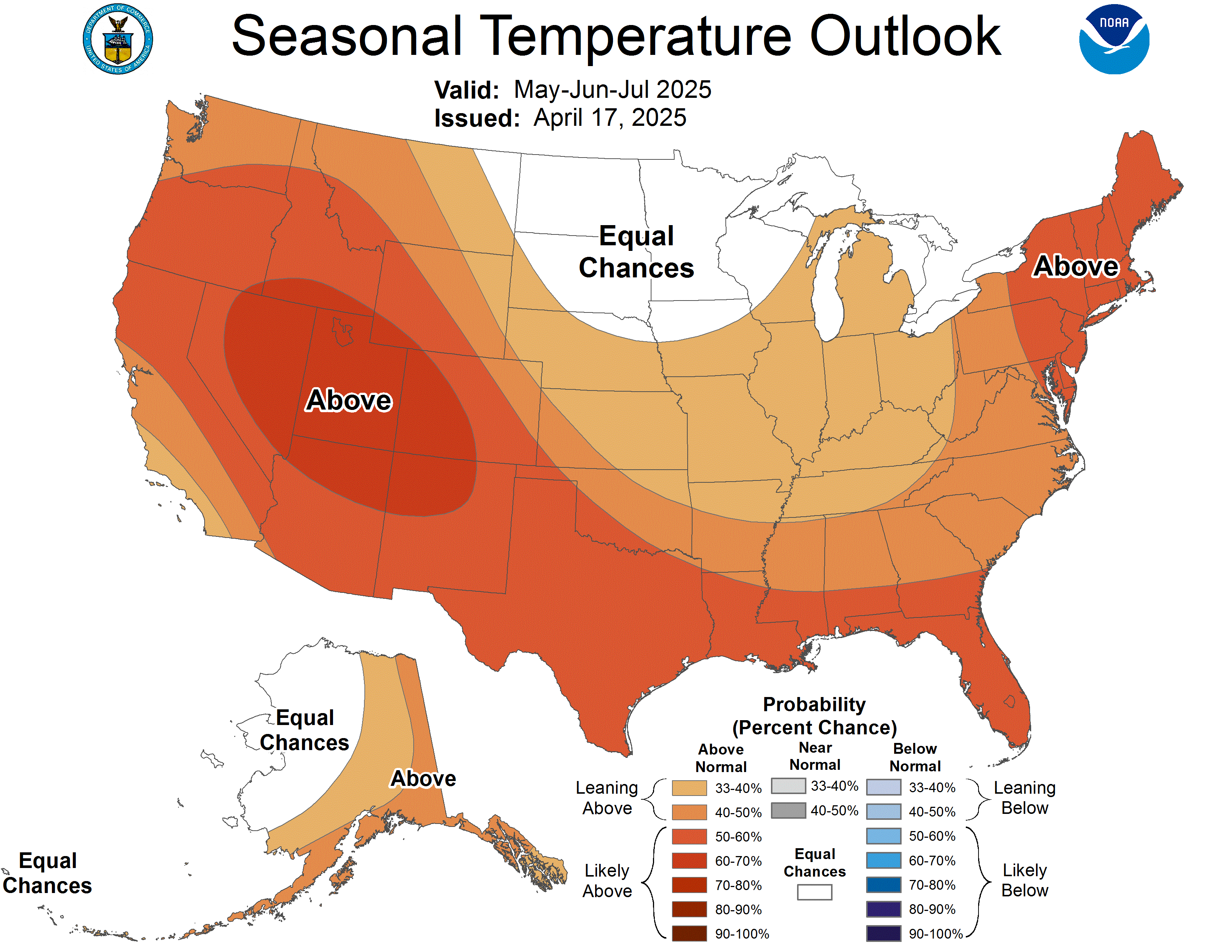
San Francisco's forecast is the cleanest outlier in the dataset: 0.00 inches of precipitation, a 2% maximum daily probability, and a 76°F average high that reflects onshore flow moderated by the marine layer rather than the ridge alone. The West Coast stays dry through at least May 23.
 NOAA CPC
International callout
London's projected 70°F average high this week is roughly 7°F above the late-May climatological normal for Heathrow, which sits near 63°F. A blocking high over Scandinavia has been the primary driver of anomalous warmth across northwestern Europe in recent weeks; if that pattern holds, the UK could log its warmest stretch of the spring by the time the weekend arrives.
The Takeaway
- May 19 is the highest-risk convective date nationally: Denver's 95% precipitation probability and Dallas's 68% probability both tie to the same trough axis, so anyone with outdoor plans along the Front Range or north Texas should treat that day as a likely disruption.
- The M6.7 near Ōfunato on May 15 is worth monitoring for aftershock activity over the next 10–14 days; the Sanriku coast has produced significant aftershock sequences historically, and the USGS hazard window for a M5.5+ aftershock following a M6.7 is non-trivial.
- Space weather is a non-factor this week — Kp at 0 and no Earth-directed CMEs on record — so HF radio operators and satellite-dependent systems can plan without geomagnetic contingencies through at least May 22.